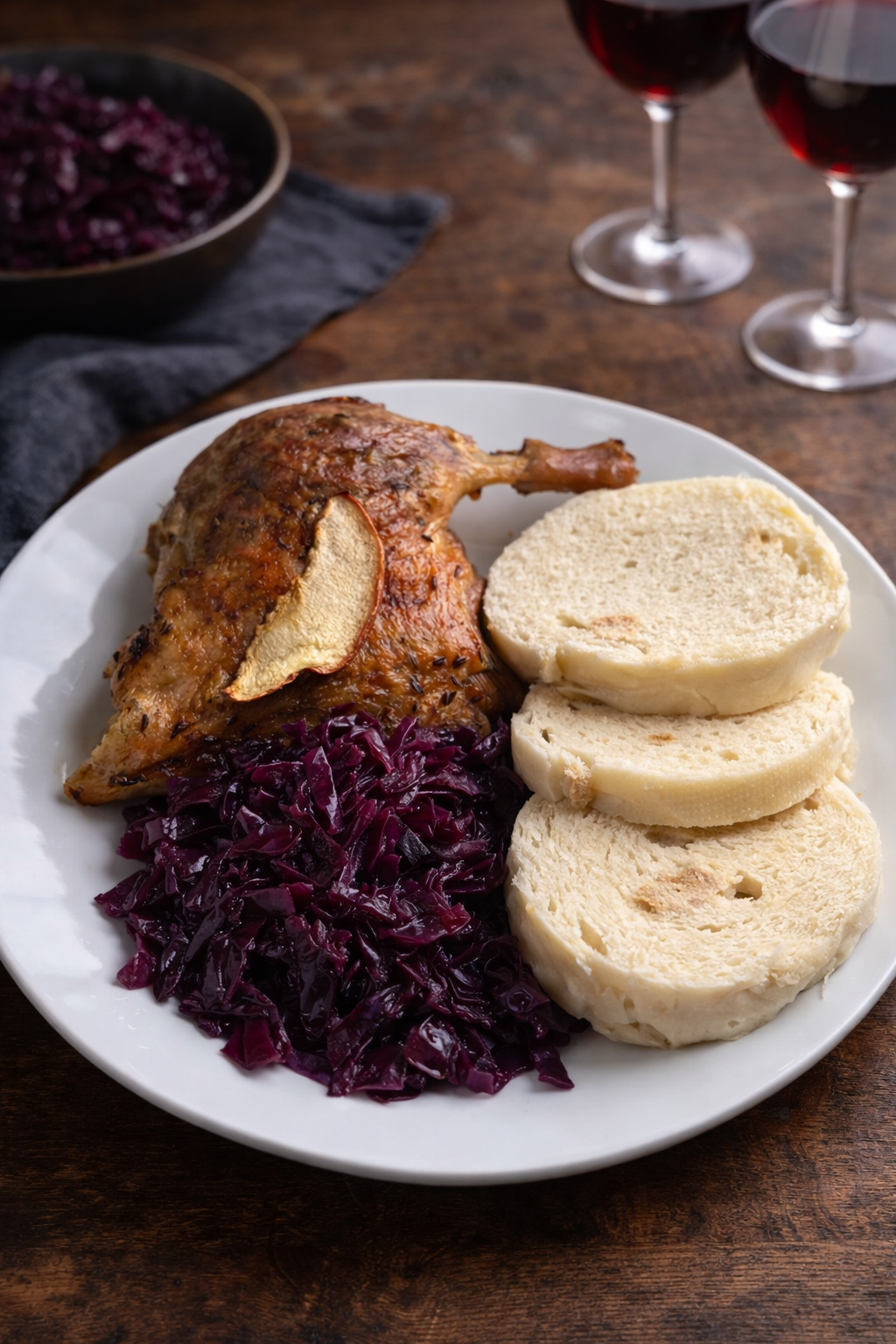
The Duck That Cooks Itself
A Feast-Day Classic from Grandma’s Kitchen
Some dishes do not need improvement.
They need time.
Salt.
Caraway.
And an oven that does its job.
This is the kind of duck that used to be roasted for village feasts —
when carousels arrived, music played, and families gathered.
It was not everyday food.
It was celebration food.
Prepared a day in advance.
Roasted slowly.
Served with pride.
On the plate, it looks exactly as it should:
honest, calm, and confident.
This is not cooking for show.
This is cooking for people.
WHY THIS RECIPE WORKS
This duck stands on simple principles:
- dry salting overnight
- slow roasting under foil
- apples as a natural base
- removing excess fat at the right moment
- high heat at the end for crisp skin
Nothing extra.
Nothing missing.
Just proven order.
INGREDIENTS
- 1 whole duck (2.5–3 kg / 5.5–6.5 lb)
- coarse salt
- whole caraway seeds, lightly crushed
- 3–4 apples
- about 50 – 100 ml water
METHOD
1. The Day Before – Salting
Clean and dry the duck thoroughly.
Rub it generously with salt on all sides, including the cavity.
Place uncovered in the refrigerator for 12–24 hours.
- This seasons the meat all the way to the bone.
2. Preparing for Roasting
Before roasting, rinse the duck briefly with cold water and pat dry.
Sprinkle with crushed caraway seeds.
Cut the apples into large pieces and place them in the bottom of a roasting pan.
Place the duck breast-side up on top.
Pour in about 100 ml of water.
Cover tightly with foil.
3. Slow Roasting
Preheat the oven to 120 °C / 250 °F.
Roast covered for:
- 3 hours
Baste lightly if needed.
4. Removing Excess Fat
After about 2 hours, uncover the pan and carefully remove part of the rendered fat.
- The duck stays lighter.
- The juices remain clean and concentrated.
Save the fat for future cooking.
5. Crisping the Skin
Increase the temperature to 220 °C / 430 °F.
Remove the foil and roast for another:
⏱️ 40–50 minutes
Baste regularly with the juices.
The skin should be:
✔️ golden
✔️ crisp
✔️ glossy
6. Resting
Let the duck rest for 10–15 minutes before carving.
RED CABBAGE (CLASSIC — NO WINE)
This is the traditional sweet-and-sour version.
Simple. Balanced. Reliable..
INGREDIENTS
- 1 small red cabbage (800 g – 1 kg / 1.7–2.2 lb)
- 1 large onion
- 2 tbsp duck fat or oil
- 3 tbsp sugar
- 3 tbsp vinegar (apple or wine vinegar)
- 1 apple, grated (optional)
- ½ tsp caraway seeds
- salt to taste
- 2–3 tbsp duck roasting juices (to finish)
METHOD
Slice the cabbage into fine strips.
Salt it lightly and massage gently.
Let rest for at least 10 minutes.
- This softens the cabbage and improves texture.
Sauté the onion in fat until golden.
Add sugar and let it caramelise lightly.
Add cabbage and caraway seeds. Stir well.
Pour in vinegar.
Cover and braise for about 40–50 minutes, until tender.
Add grated apple if using.
At the end, stir in 2–3 tablespoons of duck roasting juices.
- This connects the cabbage directly to the duck.
The cabbage should be:
✔️ tender
✔️ glossy
✔️ sweet-and-sour
✔️ never heavy
SERVING
Best served with:
- bread dumplings
- or potato pancakes (lokše)
Dumplings absorb the juices.
Pancakes spread them across the plate.
Both are right.
WINE PAIRING
Blaufränkisch
Zweigelt
Blue Portugieser
Pinot Noir
Fresh, medium-bodied reds balance fat and acidity.
RECIPE DETAILS
Preparation time: 20 minutes (+ overnight salting)
Roasting time: about 3 h 45 min
Total time: approx. 4 hours
Servings: 4–6
Difficulty: low, based on patience
A recipe built on time, not technique.
The oven does most of the work.
You simply keep an eye on it.