
Wandering from Athens to an Unknown Restaurant Somewhere in the Peloponnese
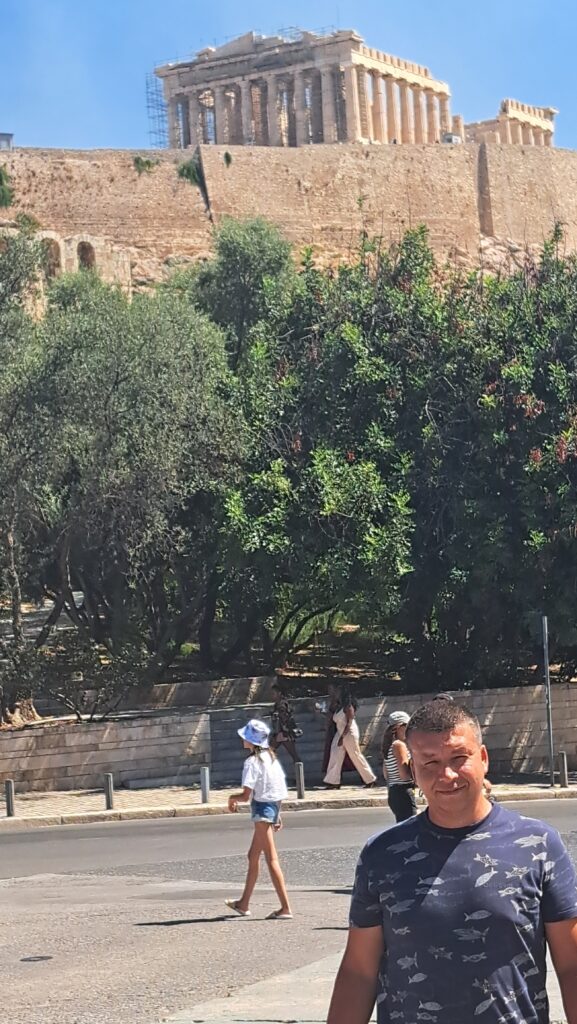
This time, Greece was not just about the sea. From Athens, we continued into the Peloponnese – from the Acropolis to ancient Olympia and eventually to the much quieter area of Kalogria.
In the Peloponnese, we stayed in the Kalogria area, surrounded by protected nature, the Strofylia coastal forest and wetlands. Its long sandy beach was beautiful, and at times it felt as though we practically had it all to ourselves.

A Little History, a Little Sport…
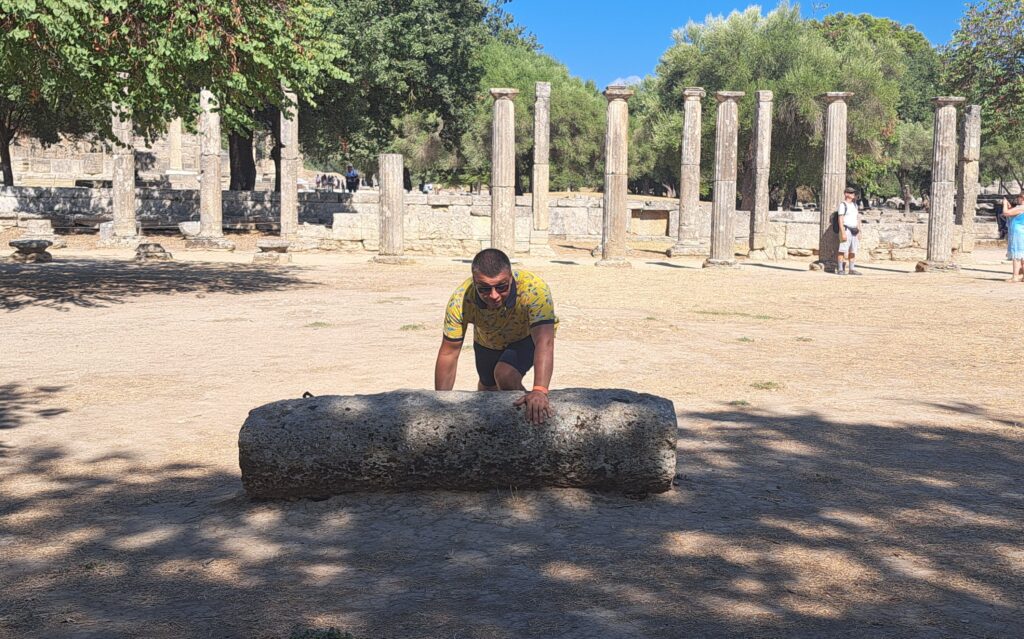
While exploring the Peloponnese, we naturally couldn’t miss ancient Olympia.
And when you visit the birthplace of the Olympic Games, it seems only appropriate to test your own athletic abilities.
The ancient column remained exactly where it was, but at least I tried.
And Then Came Saganaki
Somewhere during our travels through the Peloponnese, my daughter and I came across a small, old family-run restaurant.
It wasn’t a famous place or somewhere we had chosen from an online ranking. Just a simple Greek restaurant run by a lovely older couple.
And that was where we discovered saganaki.
For someone from Slovakia, the first thought is almost inevitable:
Is this the Greek version of our fried cheese?
Well, yes – but only to a certain extent.
Saganaki is actually not the name of one particular cheese. The name comes from the small frying pan traditionally used to prepare the dish. Cheese saganaki can be made with several firm Greek cheeses, such as kefalograviera, kefalotyri or graviera, many of which are traditionally produced from sheep’s milk or a combination of sheep’s and goat’s milk.
Unlike the classic Slovak fried cheese, however, the Greeks don’t need a thick breadcrumb coating.
The cheese is lightly coated in flour and fried quickly until a golden crust forms on the outside, while the inside becomes soft without completely melting.
And instead of our beloved tartar sauce?
A squeeze of fresh lemon.

Saganaki vs. Slovak Fried Cheese
The Slovak version is comfort food we know very well: cheese in a classic flour, egg and breadcrumb coating, fried until golden and usually served with French fries and a generous portion of tartar sauce.
Greek saganaki is simpler.
The flavour comes primarily from the cheese itself – stronger, saltier and firmer. The thin golden crust provides just enough crispness, while fresh lemon balances the richness and saltiness of the cheese.
And the French fries?
As you can see in the photo, apparently they work perfectly well in both countries.
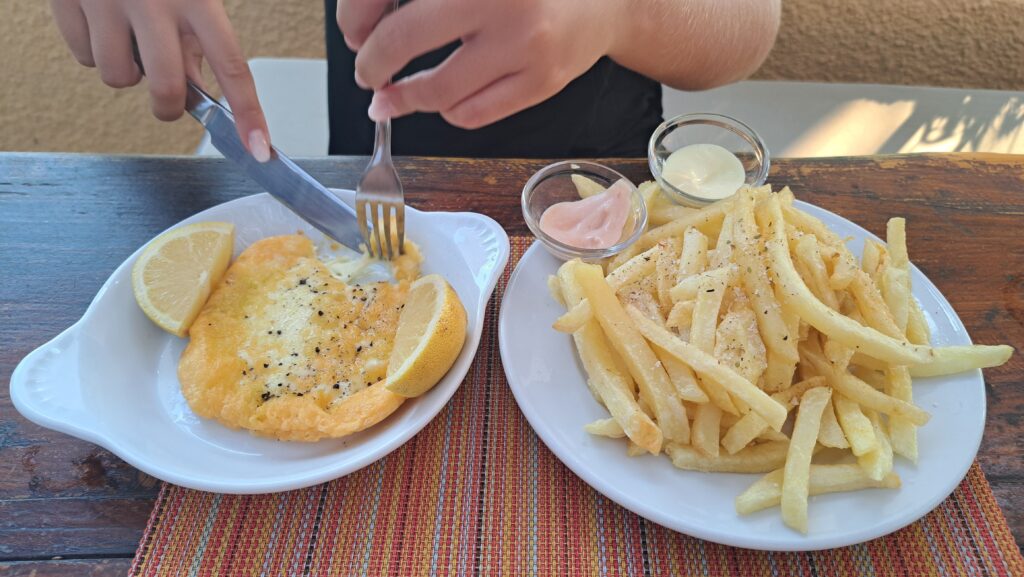
It was a simple but really delicious dish – and one we might never have discovered if we hadn’t stopped at this unassuming family restaurant somewhere in the Peloponnese.
So, if you ever find yourself in Greece and see saganaki on the menu, you’ll know what to expect.
We’ll certainly order it again.
And our Slovak fried cheese?
For now, its position remains safe.
It still has nothing to worry about.
And when we got home, we decided to find out why. We made it a little lighter – but kept what matters most.
→ Discover our slightly different take on Slovak fried cheese