Slovak Fried Cheese – A Lighter Take with Mashed Potatoes and Homemade Tartar Sauce
Introduction
Tell an American you are having fried cheese for lunch, and they will probably imagine mozzarella sticks.
In Slovakia and the Czech Republic, however, fried cheese means something quite different.
A proper thick slice of cheese is coated in flour, egg and breadcrumbs, then fried until beautifully golden and crisp on the outside while the cheese inside becomes soft, hot and irresistibly molten. In Czechia it is known as smažený sýr – or simply smažák – while in Slovakia we call it vyprážaný syr.
It is one of those dishes deeply rooted in the shared Czechoslovak culinary memory – found everywhere from school canteens and mountain cafés to traditional restaurants.
The classic combination is fried cheese, French fries and tartar sauce.
Delicious? Absolutely.
Light? Not particularly.
So we decided not to change the cheese itself. Some things are better left alone. Instead, we replaced the fries with light, silky mashed potatoes and added a sour pickle and a fresher homemade tartar sauce.
It is still unmistakably fried cheese.
You just might not need a two-hour recovery period afterwards.
Did You Know?
Fried cheese is one of the enduring classics of Czech and Slovak comfort food.
In Czechia, you will often hear it called simply smažák, while in Slovakia the usual name is vyprážaný syr.
Semi-hard cheeses work best. Eidam is perhaps the most traditional choice, although Gouda and Emmental are excellent alternatives.
The important details are a sufficiently thick slice of cheese and a well-sealed breadcrumb coating. The crust needs to become crisp before the cheese inside decides to escape into the frying pan.
And yes – tartar sauce is practically part of the institution.
Why This Recipe Works
- The cheese remains exactly what fried cheese should be – crisp outside and molten inside.
- Mashed potatoes provide a softer, lighter accompaniment than another pile of fried food.
- Sour pickles bring acidity that cuts through the richness of the cheese and mayonnaise.
- Finely chopped pickles and fresh herbs make the tartar sauce brighter and more interesting.
- The result remains unmistakably Central European comfort food, but the whole plate feels considerably more balanced.
Ingredients (Serves 4)
For the Fried Cheese
- 4 thick slices of Eidam, Gouda or Emmental, approximately 120–150 g each
- 80 g plain flour
- 2–3 eggs
- 120–150 g fine breadcrumbs
- neutral oil for frying
- a pinch of salt for the eggs
For the Light Mashed Potatoes
- 800 g floury potatoes
- 120–150 ml warm milk
- 25–30 g butter
- salt
- a small pinch of nutmeg – optional
For the Homemade Pickle Tartar Sauce
- 150 g good-quality mayonnaise
- 2 small sour pickles or gherkins
- 1 tsp Dijon mustard
- 1–2 tsp pickle brine
- 1 small shallot – optional
- fresh dill or chives
- freshly ground black pepper
To Serve
- sour pickles or gherkins
- fresh dill or chives
Method
Fried Cheese
Cut the cheese into slices approximately 1–1.5 cm thick.
If the cheese is too thin, it is more likely to melt and escape before the coating has had enough time to become crisp and golden.
Prepare three shallow bowls: one with flour, one with beaten eggs and one with breadcrumbs.
Coat each piece of cheese first in flour, then egg and finally breadcrumbs.
For extra insurance against leaking cheese, repeat the egg and breadcrumb stages, paying particular attention to the edges.
Let the coated cheese rest in the refrigerator for approximately 10 minutes.
Heat the oil and fry the cheese briefly on both sides until golden and crisp.
The aim is not to fry it for a long time. We want to create the crust quickly while gently melting the cheese inside.
Transfer briefly to a paper towel to remove excess oil.
And then work quickly – fried cheese waits for no one.
Light Mashed Potatoes
Peel and cut the potatoes, then cook them in salted water until tender.
Drain thoroughly and mash while still hot.
Add the butter and gradually incorporate the warm milk until the potatoes become smooth, light and silky.
There is no need for large quantities of butter or cream here.
The mashed potatoes are supposed to balance the richness of the fried cheese – not compete with it for the title of heaviest thing on the plate.
Season with salt and, if you like, a very small pinch of nutmeg.
Homemade Pickle Tartar Sauce
Finely dice the sour pickles.
Combine them with the mayonnaise, Dijon mustard and a little pickle brine.
For a slightly sharper version, add some very finely chopped shallot.
Finish with fresh dill or chives and freshly ground black pepper.
Let the sauce rest in the refrigerator for at least 15–20 minutes before serving.
TGCC Shortcut
You do not always need to make tartar sauce completely from scratch.
Take a good-quality ready-made tartar sauce and add finely chopped sour pickles, a small splash of pickle brine and some fresh dill or chives.
A tiny adjustment – but a surprisingly big improvement.
Serving
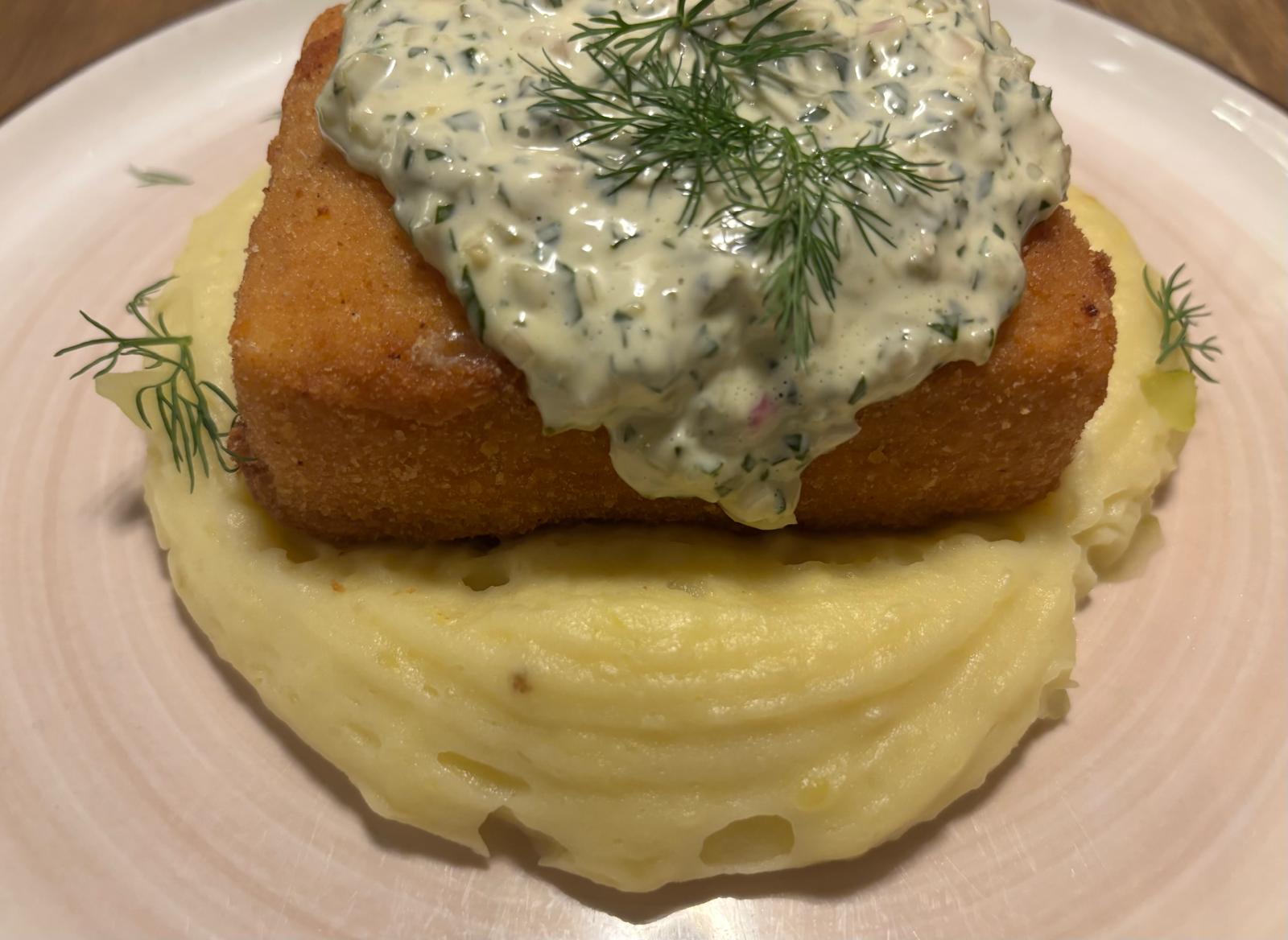
Spoon the mashed potatoes onto the plate and place the freshly fried cheese on top.
Add a generous spoonful of tartar sauce.
And definitely serve it with a sour pickle.
It is not there simply for decoration.
The acidity cuts through the richness of the melted cheese and mayonnaise and makes the entire dish feel fresher and more balanced.
Finish with a little fresh dill if you like.
And then serve immediately.
There is one fundamental rule with fried cheese:
eat it while it is hot.
Wine Pairing
Fried cheese needs a wine with enough acidity to refresh the palate after each bite and balance both the richness of the cheese and the tartar sauce.
Our choices would be:
- Grüner Veltliner – dry, fresh and slightly mineral,
- Riesling – preferably dry, with lively acidity,
- Sauvignon Blanc – especially a fresh Central European style,
- or a dry Brut sparkling wine.
If we had to open just one bottle for this lighter version, we would choose a dry Riesling.
Its acidity cleans up the richness beautifully without overpowering the cheese.
Recipe Details
Cuisine: Slovak / Czechoslovak / Central European
Course: Main course
Servings: 4
Preparation: 20 minutes
Cooking: approximately 25 minutes
Total time: approximately 45 minutes
Difficulty: Easy
Behind the Recipe
Fried cheese does not need a culinary revolution.
Its charm lies precisely in its simplicity – a crisp breadcrumb coating, hot melted cheese and tartar sauce.
So rather than reinventing the classic itself, we changed what surrounds it.
French fries were replaced by light mashed potatoes, a sour pickle brought some much-needed acidity, and the tartar sauce gained a little extra character from chopped pickles and fresh herbs.
And if you are curious about what happens to fried cheese a few hundred kilometres further south, Greece offers another delicious interpretation.
On the Peloponnese, we tasted saganaki – a Greek relative of our fried cheese. No traditional breadcrumb coating, a more assertive cheese and, instead of tartar sauce, usually nothing more complicated than a squeeze of fresh lemon.
A completely different culinary tradition built around essentially the same wonderful idea:
finding a very good way to put hot cheese on a plate.
→ Read next: Saganaki – Greek Fried Cheese Discovered on the Peloponnese